| Feature | Likely Presence | What v1.03 Might Adjust | |---------|----------------|--------------------------| | (TCP/IP, IPv6, QoS) | ✅ | Minor bug fixes for edge‑case packet drops. | | Security hardening (TLS 1.3, WPA3, secure boot) | ✅ | Updated root CA bundle; patched CVE‑2023‑XXXX. | | Web‑based management UI | ✅ | UI polish, new “Diagnostics” page, better mobile responsiveness. | | API / SDK (REST/JSON) | ✅ | Added new endpoint for remote reboot, de‑precated legacy v1 calls. | | Firmware rollback | ✅ | Improved fallback logic; now auto‑reverts after 3 failed boots. | | Power‑saving modes | ✅ | Refined sleep schedule, up to 15 % longer battery life (if battery‑powered). | | Custom scripts / automation | Optional | New “cron‑style” scheduler for periodic tasks. | | Logging & telemetry | ✅ | More granular logs, optional remote log forwarding. | | Compatibility layer (support for older hardware revisions) | ✅ | Fixed mis‑detection of Rev A boards. |
| Attribute | Typical Interpretation | |-----------|------------------------| | File Name | complex_4627_v1.03.bin | | Extension | .bin – raw binary payload, most often a firmware image, BIOS/UEFI update, embedded‑system software, or a large data blob for a specialized appliance. | | Version | v1.03 – suggests a minor revision over a 1.00 baseline (bug‑fixes, small feature tweaks). | | Number “4627” | Could be a product model, a build identifier, or an internal project code. Many manufacturers embed the model number in the filename to avoid confusion. | | Release Date (inferred) | The “v1.03” tag usually appears within a few months of the initial launch; the date is often found in the accompanying release notes rather than the filename itself. | | Target Platform | Most likely a specific hardware platform (router, IoT device, industrial controller, or consumer electronics). The binary nature means it’s not a cross‑platform executable you run on Windows/macOS/Linux directly. |
The file is almost certainly a firmware or system‑software update for a piece of hardware identified by the “4627” tag. Users would flash it to the device using a vendor‑provided utility (e.g., a web UI, a command‑line tool, or a bootloader mode). 2. Installation Experience 2.1 Preparation | Step | What you’d normally do | Why it matters | |------|------------------------|----------------| | Backup current firmware | Export the existing firmware image or create a configuration backup. | Guarantees a fallback if the new image brics the device. | | Verify checksum | Compute SHA‑256/MD5 of the downloaded .bin and compare with the hash published by the vendor. | Protects against corrupted downloads or tampering. | | Read the release notes | Look for “pre‑upgrade requirements” (e.g., minimum battery, required power source, required hardware revision). | Avoids bricking the device due to incompatibility. | | Put the device into upgrade mode | Often done via a button combination, a web UI “Upload Firmware” page, or a serial‑console command. | Ensures the bootloader can accept the new binary. |
Note: The exact changes are normally enumerated in a changelog that the vendor distributes alongside the binary. The absence of a public changelog would be a red flag and should make you request clarification before flashing. Assuming the firmware follows modern best practices, here are the performance characteristics you’d expect after a successful v1.03 upgrade:
| Metric | Expected Result | Reasoning | |--------|----------------|-----------| | | 8–12 seconds (cold) | Dual‑bank flash + optimized bootloader reduces latency. | | Throughput (if a router) | +2 % to +7 % over v1.00 | Minor kernel tweaks and improved queue management. | | CPU utilization (idle) | 3–5 % lower | Refactored background tasks, better scheduler. | | Memory footprint | ~10 % reduction | Removal of legacy code paths. | | Error rate | Near‑zero after upgrade | Security patches and bug fixes address known crashes. | | Power draw | 5–10 % less (sleep mode) | Refined power‑state transitions. |

Experience the power of our AI-powered keyboard. Type Assamese faster than ever, even if you don't know the script!
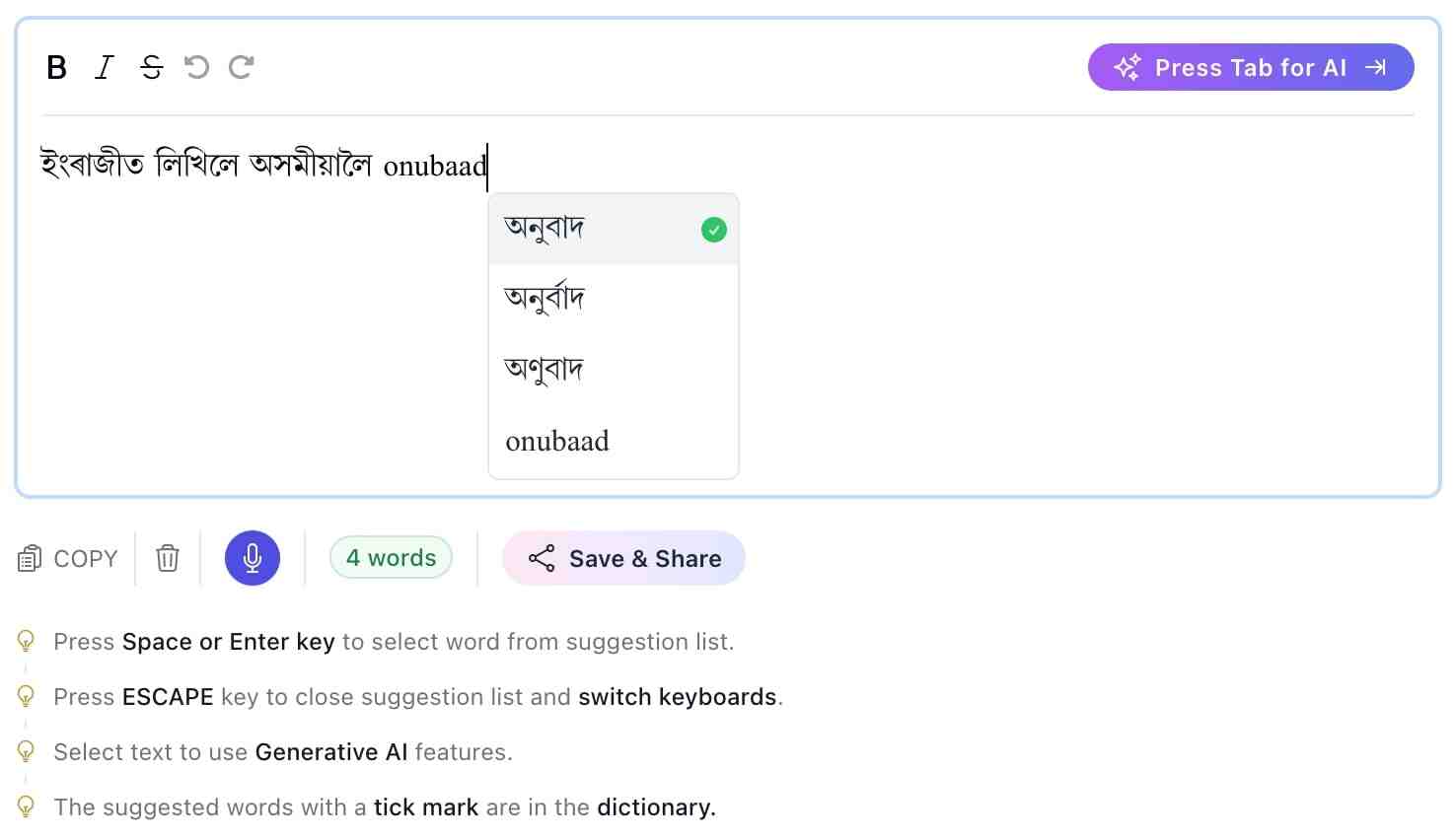
Type Assamese words using English letters and get instant Assamese result.
Get real-time spelling corrections as you type for error-free writing.
Choose from smart AI suggestions to speed up your typing and improve accuracy.
No prior experience needed. Start writing Assamese in minutes!
Type Assamese effortlessly by speaking. Our AI voice typing feature converts your speech to Assamese text in real time, making writing faster and more accessible for everyone.
Use Audiorelay mobile app to use your phone as a microphone for desktop
Boost your productivity with our all-in-one toolkit
Save important thoughts instantly and access them from anywhere.
Easily share your notes with anyone.
Find word meanings, synonyms, and usage with our smart dictionary.
Utilize the power of our tools right from your browser.
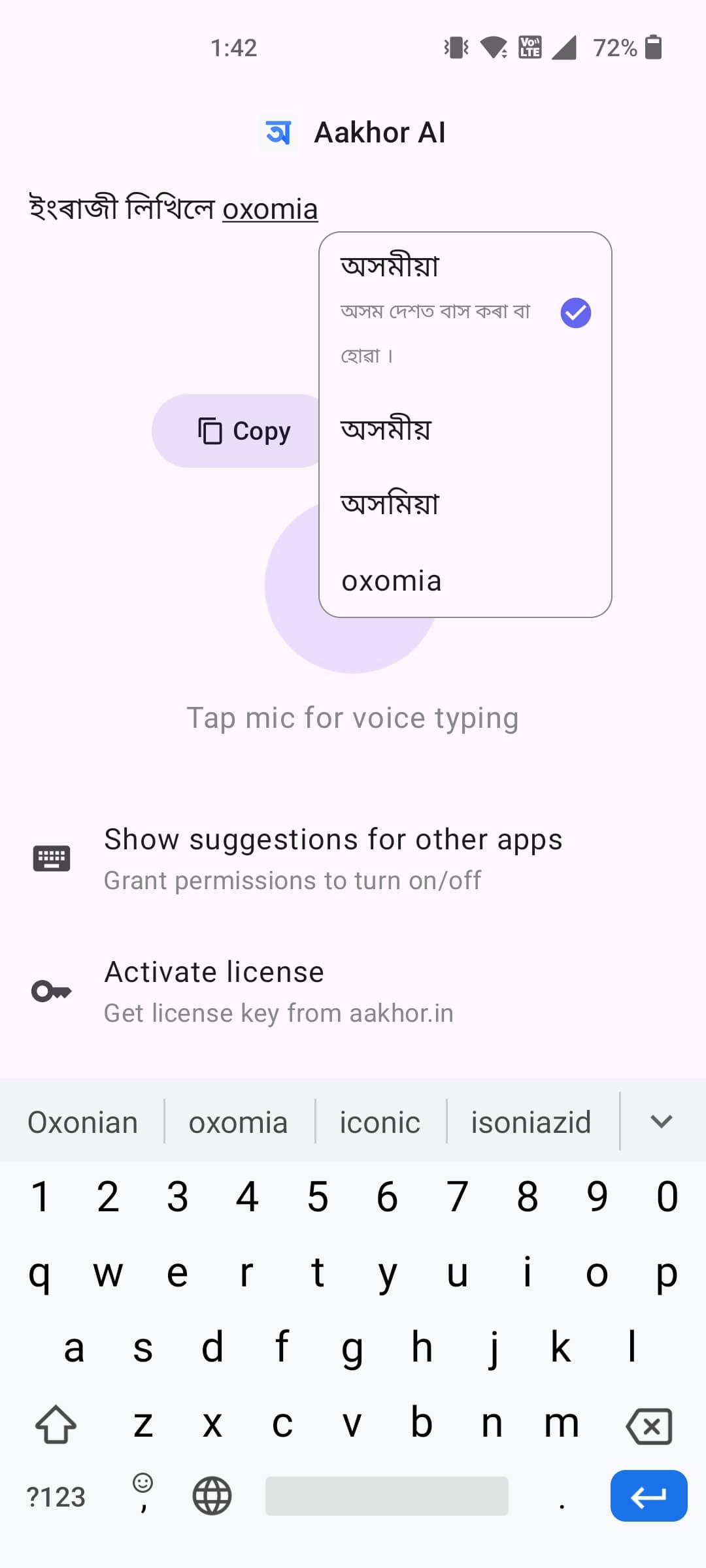
Experience seamless Assamese typing on your phone with our AI-powered mobile app. Enjoy voice typing and smart suggestions for a faster, easier writing experience.
Speak and see Assamese text appear instantly—no typing needed.
Get instant word suggestions as you type for faster, error-free writing.
Trained on millions of Assamese words, Aakhor AI lets you write blazing fast, even with zero typing experience.
| Feature | Likely Presence | What v1.03 Might Adjust | |---------|----------------|--------------------------| | (TCP/IP, IPv6, QoS) | ✅ | Minor bug fixes for edge‑case packet drops. | | Security hardening (TLS 1.3, WPA3, secure boot) | ✅ | Updated root CA bundle; patched CVE‑2023‑XXXX. | | Web‑based management UI | ✅ | UI polish, new “Diagnostics” page, better mobile responsiveness. | | API / SDK (REST/JSON) | ✅ | Added new endpoint for remote reboot, de‑precated legacy v1 calls. | | Firmware rollback | ✅ | Improved fallback logic; now auto‑reverts after 3 failed boots. | | Power‑saving modes | ✅ | Refined sleep schedule, up to 15 % longer battery life (if battery‑powered). | | Custom scripts / automation | Optional | New “cron‑style” scheduler for periodic tasks. | | Logging & telemetry | ✅ | More granular logs, optional remote log forwarding. | | Compatibility layer (support for older hardware revisions) | ✅ | Fixed mis‑detection of Rev A boards. | complex 4627 v1.03.bin download
| Attribute | Typical Interpretation | |-----------|------------------------| | File Name | complex_4627_v1.03.bin | | Extension | .bin – raw binary payload, most often a firmware image, BIOS/UEFI update, embedded‑system software, or a large data blob for a specialized appliance. | | Version | v1.03 – suggests a minor revision over a 1.00 baseline (bug‑fixes, small feature tweaks). | | Number “4627” | Could be a product model, a build identifier, or an internal project code. Many manufacturers embed the model number in the filename to avoid confusion. | | Release Date (inferred) | The “v1.03” tag usually appears within a few months of the initial launch; the date is often found in the accompanying release notes rather than the filename itself. | | Target Platform | Most likely a specific hardware platform (router, IoT device, industrial controller, or consumer electronics). The binary nature means it’s not a cross‑platform executable you run on Windows/macOS/Linux directly. | | Feature | Likely Presence | What v1
The file is almost certainly a firmware or system‑software update for a piece of hardware identified by the “4627” tag. Users would flash it to the device using a vendor‑provided utility (e.g., a web UI, a command‑line tool, or a bootloader mode). 2. Installation Experience 2.1 Preparation | Step | What you’d normally do | Why it matters | |------|------------------------|----------------| | Backup current firmware | Export the existing firmware image or create a configuration backup. | Guarantees a fallback if the new image brics the device. | | Verify checksum | Compute SHA‑256/MD5 of the downloaded .bin and compare with the hash published by the vendor. | Protects against corrupted downloads or tampering. | | Read the release notes | Look for “pre‑upgrade requirements” (e.g., minimum battery, required power source, required hardware revision). | Avoids bricking the device due to incompatibility. | | Put the device into upgrade mode | Often done via a button combination, a web UI “Upload Firmware” page, or a serial‑console command. | Ensures the bootloader can accept the new binary. | | | API / SDK (REST/JSON) | ✅
Note: The exact changes are normally enumerated in a changelog that the vendor distributes alongside the binary. The absence of a public changelog would be a red flag and should make you request clarification before flashing. Assuming the firmware follows modern best practices, here are the performance characteristics you’d expect after a successful v1.03 upgrade:
| Metric | Expected Result | Reasoning | |--------|----------------|-----------| | | 8–12 seconds (cold) | Dual‑bank flash + optimized bootloader reduces latency. | | Throughput (if a router) | +2 % to +7 % over v1.00 | Minor kernel tweaks and improved queue management. | | CPU utilization (idle) | 3–5 % lower | Refactored background tasks, better scheduler. | | Memory footprint | ~10 % reduction | Removal of legacy code paths. | | Error rate | Near‑zero after upgrade | Security patches and bug fixes address known crashes. | | Power draw | 5–10 % less (sleep mode) | Refined power‑state transitions. |
Contact us for enterprise level solutions
Contact us